
For years, Skinwalker Ranch has stood at the center of discussions about unexplained aerial sightings, unusual electromagnetic activity, and stories that blur the line between folklore and scientific curiosity. Now, another location has entered that conversation: Mount Shasta in Northern California. Featured in a recent investigation connected to Skinwalker Ranch, the mountain became the focus of an experiment designed to see whether similar patterns might appear outside Utah. Rather than attempting to prove any long-standing legends, the team set out to document what could actually be observed using advanced equipment. What followed did not settle the mystery, but it introduced several intriguing moments that continue to spark discussion among longtime followers of the series and those fascinated by unexplained phenomena.
A Familiar Investigation Moves to an Unfamiliar Mountain
Mount Shasta has long been associated with stories involving strange lights, unusual encounters, and unexplained experiences. According to the investigation featured in the program, researchers had been hearing about the California mountain for years because many reported phenomena appeared remarkably similar to those documented at Skinwalker Ranch. Investigator Paul Beban, alongside Andy Bustamante, traveled to the area to meet Sheriff Jeremiah LaRue, who has spoken with numerous local residents about unusual reports.
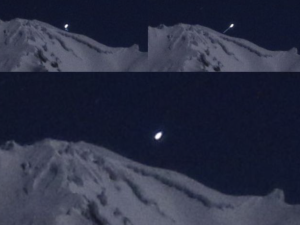
During their discussions, Sheriff LaRue described the wide variety of experiences people have claimed over the years. Some visitors reported seeing mysterious orbs, while others described unidentified aerial objects or even unusually tall glowing figures in remote locations. The investigation did not present these reports as verified facts. Instead, they served as background that encouraged the team to conduct a controlled nighttime observation using equipment capable of detecting activity beyond the visible spectrum. For newcomers to the series, this approach reflects the show’s recurring emphasis on collecting measurable data before drawing conclusions.
The team established an observation site with several specialized instruments, including a high-definition FLIR thermal imaging camera, AI-powered UFODAP sky-monitoring systems, flight tracking software, satellite tracking tools, and radio spectrum analyzers. Their objective was straightforward: monitor the skies, eliminate known aircraft and satellites whenever possible, and document anything that appeared unusual. The equipment represented some of the most advanced technology the investigators had used, giving them new opportunities to compare Mount Shasta with previous experiments conducted at Skinwalker Ranch.
Why One Audio Tone Became the Center of the Discussion
One of the most talked-about moments came when the investigators repeated an experiment previously associated with Skinwalker Ranch. They played a 192-hertz tone, a frequency that had reportedly coincided with unusual observations during earlier investigations. The goal was not to trigger unexplained activity but to see whether any measurable environmental changes might occur under similar conditions.
Shortly after the tone began playing, the radio spectrum analyzer displayed several unexpected peaks between approximately 1.4 and 1.8 gigahertz. According to the program, this range is sometimes associated with Earth-to-space or space-to-Earth communications, although the investigators emphasized that the readings alone could not identify their source. The timing appeared noteworthy because the spikes seemed to emerge after the tone was introduced, yet the team acknowledged that the relationship remained uncertain. Rather than presenting the sequence as evidence of cause and effect, they treated it as an observation deserving additional study.
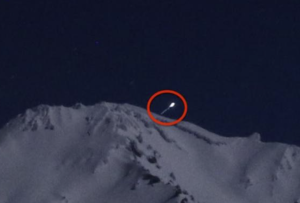
At nearly the same time, the thermal imaging camera detected several fast-moving heat signatures crossing the sky. Some appeared to move toward Mount Shasta, while others traveled at noticeably different speeds despite showing similar thermal characteristics. The UFODAP systems also recorded objects that drew the investigators’ attention. Because conventional flight and satellite tracking tools did not immediately identify the objects, the team classified them as unidentified aerial phenomena (UAPs). They were careful to explain that “unidentified” simply means the objects had not yet been explained, not that they represented anything extraordinary or supernatural.
These observations quickly became one of the most discussed aspects of the investigation because they appeared to echo patterns previously documented at Skinwalker Ranch. The investigators wondered whether the apparent similarities could point to comparable environmental conditions or simply reflect coincidences that require further examination. Viewers have also speculated about whether locations like Mount Shasta share characteristics that make them particularly interesting for future scientific studies. Even so, the episode repeatedly stresses that these possibilities remain unclear, and no definitive explanation has been confirmed.
A Mystery That Continues to Expand Beyond One Location
Perhaps the most significant outcome of the Mount Shasta investigation is not that it answered old questions but that it broadened the scope of the conversation. For years, Skinwalker Ranch has been viewed as a uniquely unusual location. By documenting observations at another site with a long history of unexplained reports, the investigation raises the possibility that researchers may benefit from comparing multiple locations rather than focusing on only one.
The investigators themselves remained cautious when reviewing their findings. Although they observed thermal anomalies, radio spectrum changes, and unidentified aerial activity during the experiment, they repeatedly acknowledged that these events had not been explained. They noted that the objects could eventually have entirely conventional explanations, even if none were immediately available during the investigation. That distinction between observation and interpretation remains one of the program’s defining characteristics and helps separate documented events from broader theories.
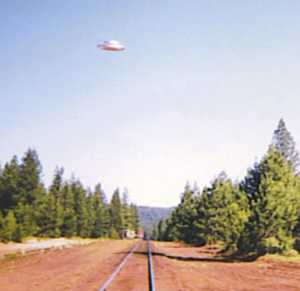
For those following the series, Mount Shasta now occupies an especially interesting place in the larger mystery. The investigation may suggest intriguing parallels with Skinwalker Ranch, but it stops well short of declaring the two locations identical. Instead, it leaves audiences with a series of thoughtful questions: Why do similar reports appear in different places? Could recurring patterns point to something worth studying more closely, or are they the result of unrelated events that simply look alike? Until future investigations provide additional evidence, Mount Shasta remains less a solved mystery than a compelling chapter in an ongoing search for answers—one that continues to inspire curiosity without claiming certainty.
