
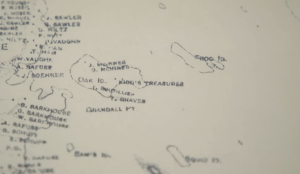
A few handwritten words on an old map have brought one of Oak Island’s most enduring pirate theories back into focus. While examining the document, Charles Barkhouse and Randall Sullivan noticed the phrase “Kidd’s treasure” written directly beside a location associated with the island. The marking does not establish that Captain William Kidd buried valuables there, nor does it prove that the map’s creator possessed reliable knowledge of any hidden cache. What makes the discovery compelling is the possibility that the connection between Kidd and Oak Island was already circulating when the map was produced. Rather than offering a solution, the Kidd’s Treasure Map creates a new historical question: was the inscription based on evidence, local tradition, or an earlier treasure story now lost to time? That uncertainty gives the document value beyond its dramatic wording and makes it worth examining carefully.
A Handwritten Clue Hidden in Plain Sight
The discovery emerged when Charles Barkhouse and Randall Sullivan studied an older map connected to the continuing search around Oak Island. Barkhouse has long been associated with the island’s history and the many stories that have accumulated around its underground mystery, while Sullivan approached the material with an interest in separating documented history from later legend. As they looked more closely at the map, their attention settled on a short but striking label: “Kidd’s treasure.” The words appeared to connect the island directly with the famous pirate captain, making the map more than a simple representation of the coastline. For viewers unfamiliar with the wider mystery, that phrase matters because Captain Kidd has often appeared in theories about lost treasure, hidden routes and secret deposits. However, the programme material does not establish who wrote the label, when it was added, or what information the writer may have possessed.
That distinction is essential because old maps can contain several layers of information created at different times. A map may begin as a practical geographical document and later receive handwritten notes, interpretations or speculative additions from another owner. Without confirming the age of the inscription, the identity of the writer and the document’s chain of ownership, the words cannot automatically be treated as contemporary evidence of Kidd’s activities. Even so, the label remains historically interesting because someone considered the connection important enough to record directly on the page. The note may reflect a local story that was already established, a theory held by an earlier researcher, or information believed to come from another source. Each possibility carries a different meaning, and none has yet been confirmed. The real significance of the map therefore lies not only in what it says, but in the unanswered question of why someone chose to say it.
The map also gives physical form to a legend that is usually discussed through stories, rumours and later speculation. Instead of hearing that Captain Kidd might have been linked to Oak Island, audiences can see a document on which that association was deliberately written. That visual element makes the clue unusually memorable, especially in an investigation where many theories depend on fragments of historical context. Yet the presence of the words should not be confused with proof that the treasure itself existed or was placed on the island. At most, the map shows that an unknown person believed, suspected or wished to record a connection between Kidd and the location. That is a narrower conclusion, but it is also a more credible one. By treating the inscription as a historical lead rather than a solved mystery, the researchers preserve its intrigue without overstating its evidential value.
Why the Kidd Connection Raises Bigger Questions
Captain William Kidd remains a powerful figure in treasure folklore because his documented life became entangled with stories of missing wealth. Over time, his name has been attached to numerous islands, coastlines and supposed burial sites, often with little evidence connecting him to those locations. This makes any reference to “Kidd’s treasure” immediately attractive, but it also demands caution. The inscription on the Oak Island map may suggest that the association has deeper roots than a modern television-era theory, although that depends entirely on when the note was written. Should researchers establish that the words are genuinely old, the discovery could point to an earlier stage in the development of the island’s pirate narrative. It would still not demonstrate that Kidd visited the island, but it might show that people were making that connection long before the present investigation.
The most valuable question is therefore not simply whether the map identifies a treasure site. A stronger line of inquiry asks what source, story or tradition led the writer to use Captain Kidd’s name in the first place. Perhaps the author had encountered an older account that is no longer known, or perhaps the phrase reflected a popular belief already circulating among treasure seekers. It is equally possible that the inscription was speculative and based on Kidd’s reputation rather than on specific historical knowledge. The team wondered whether the wording preserved an overlooked tradition, but the available detail does not allow that possibility to be treated as fact. Establishing the map’s date, materials, handwriting and ownership history would be necessary before stronger conclusions could be considered. Until then, the label is best understood as evidence of a belief about treasure, not evidence of the treasure itself.
This difference between a documented belief and a documented event is especially important in the wider Oak Island mystery. The island has attracted generations of searchers partly because multiple theories can be fitted around the same unexplained features and historical gaps. A pirate connection offers an appealing narrative because it provides a recognisable figure, a motive for secrecy and the possibility of transported wealth. Yet a compelling story is not automatically the most historically likely explanation. The Kidd’s Treasure Map may strengthen the case that the pirate theory has a history of its own, but it does not necessarily strengthen the case that the theory is correct. In other words, the document could be highly useful for tracing the evolution of the legend even if it never leads to buried valuables. That makes it a meaningful clue for researchers interested in how the Oak Island story was formed, transmitted and repeatedly reinterpreted.
A Map That Deepens the Mystery Without Solving It
The inscription remains important because it gives investigators a specific object that can potentially be dated, traced and compared with other records. Unlike a broad oral tradition, a physical map may retain clues in its paper, ink, handwriting and previous ownership. Those details could help determine whether “Kidd’s treasure” was written near the time the document was created or added many years later. If the note proves relatively recent, it may reveal more about the interests of past treasure hunters than about Captain Kidd himself. If it proves significantly older, it could raise fresh questions about when the pirate association first entered Oak Island history. Either result would add useful context, even though neither would confirm the existence of treasure.
The discovery also illustrates why the island’s mystery continues to hold attention after so many competing theories. The most intriguing clues are often not dramatic objects pulled from the ground, but small details that alter the timeline of what people believed and when they believed it. A handwritten phrase can become significant because it may preserve a forgotten connection between a place and a historical legend. At the same time, the phrase can mislead when it is separated from its uncertain origin and presented as direct evidence. The responsible approach is to keep both possibilities visible: the map may contain an important historical lead, or it may simply record an old piece of speculation. That tension between possibility and proof is precisely what keeps the document open to further investigation.

For those following the mystery, the next meaningful development would not necessarily be another theory about what Kidd might have hidden. More valuable progress would come from establishing the history of the map itself and identifying the person who wrote the inscription. A confirmed date could reveal whether the wording predates modern versions of the Captain Kidd theory, while a handwriting match could connect the note to a known researcher, collector or owner. Until such evidence emerges, the map remains a provocative but unresolved piece of the larger puzzle. It does not solve Oak Island’s hidden past, and it does not confirm that pirate treasure was ever buried there. What it does provide is a clear reason to revisit how early the Kidd legend became attached to the island. Sometimes a mystery grows not because a clue gives an answer, but because it shows that the unanswered question may be older than anyone realised.
