At the ranch, the sky is not just something to watch. It is something the team keeps trying to measure, challenge, and understand from different angles. Drones offer control, stability, and detailed aerial views, while rockets create a very different kind of test by moving quickly through vertical space and interacting with the environment in a more direct way. That contrast makes the rocket-versus-drone question more interesting than it may first appear. The team does not use one simply because it looks more dramatic on screen. Each tool can expose different problems, different readings, and different blind spots. The real question is not which one is better, but why both may be necessary when the mystery seems to shift between the ground, the air, and the unseen layers in between.
Two Tools, Two Very Different Ways of Testing the Sky
Rockets and drones serve different purposes in the ranch investigation, even when both appear to be aimed at the same general target: the airspace above the property. A drone is controlled, repeatable, and useful for gathering visual data from a stable position. It can hover, move slowly, follow a planned route, and capture footage from angles that would be difficult or unsafe for people on the ground. That makes it valuable when the team needs to map terrain, observe the mesa, inspect an area from above, or compare visual details over time. A drone gives investigators patience in the air. It is designed for observation, not disruption.
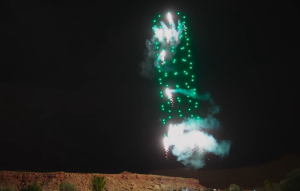
A rocket works differently because it introduces speed, altitude, and a sudden vertical event into the environment. Unlike a drone, it does not hover in place or calmly survey the land. It rises quickly through the air column, giving researchers a way to test whether something unusual happens along a vertical path. That can matter in a location where past experiments have often focused on strange readings, aerial anomalies, and possible zones of interest above the ranch. A rocket may be useful not because it is more advanced than a drone, but because it forces the investigation to ask a different type of question. Instead of only asking what can be seen from above, the team can ask what happens when an object moves through the area.
This difference helps explain why both tools can appear in the same investigative world without replacing each other. Drones are better for controlled observation and extended monitoring. Rockets are better for brief, high-energy tests that may reveal reactions, signal changes, tracking issues, or environmental responses during launch and flight. If a drone is like a careful scout, a rocket is more like a probe sent through a suspicious corridor. Neither tool automatically explains the ranch mystery. But each one gives the team a different way to look for patterns that may not appear during ordinary observation.
What Rockets May Detect That Drones Cannot Easily Capture
The strongest argument for using rockets is that they can test vertical space in a way drones often cannot. A drone can rise, hover, and move with precision, but it usually does so slowly and under controlled flight limits. A rocket travels upward quickly, creating a narrow window where multiple instruments can watch for changes at the same time. If the team is studying whether a particular area above the ranch produces unusual readings, a rocket can act as a moving marker through that zone. Cameras, tracking systems, radar, GPS tools, and spectrum equipment can then compare what happens before, during, and after the launch. That makes the rocket useful as part of a larger experiment, not just as a flying object.
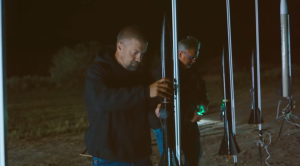
Rockets may also create moments where unusual behavior becomes easier to notice. If a signal appears only when an object enters a specific part of the sky, a slow drone might miss the effect or blend it into ordinary background data. A rocket’s quick movement can create a clearer timeline for comparison. Did the reading appear before launch, during ascent, at a certain altitude, or after the object passed through the target zone? Those timing questions are important because the ranch mystery often depends on whether different events are connected or merely coincidental. A rocket gives the team a sharp event marker that can be compared against other instruments.
Drones still have advantages that rockets do not. A drone can return to the same position, record longer footage, and inspect features with far more control. It can also carry cameras or sensors that provide detailed views of the land and structures below. But drones may be less useful when the team wants to test a sudden response in the airspace rather than simply observe it. This is why the debate should not be framed as rockets versus drones in a simple contest. The better question is how each tool exposes a different layer of uncertainty. In a mystery where the environment madifferently depending on timing, altitude, and movement, the team needs more than one method.
Why the Ranch Investigation Needs Both Precision and Provocation