
At Skinwalker Ranch, the most unsettling moments are not always the ones people can see. Sometimes, the mystery begins with a quiet screen, a stable radio spectrum, and a sudden burst of activity where no one expected it. In the investigation described in the transcript, Andy Bustamante and Paul Beban monitored the 1.4–1.8 GHz range while testing a 192-hertz tone connected to earlier ranch experiments. That frequency window drew attention because the program explains it can be associated with Earth-to-space or space-to-Earth communication, while also noting that such readings may sometimes appear during UAP-related observations. The team did not treat the signal as proof of anything extraordinary. But when the peaks appeared after the tone was played, the question became impossible to ignore: why did this range respond when others remained quiet?
The Frequency Window That Suddenly Became Important
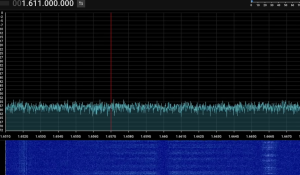
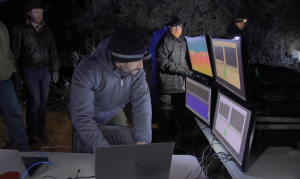
The focus on the 1.4–1.8 GHz range appeared during a night investigation built around careful observation, not instant conclusions. Andy Bustamante and Paul Beban were using a combination of radio spectrum equipment, flight tracking, satellite tracking, UFODAP sky-monitoring systems, and thermal imaging to watch for unusual activity. Before the key moment, the spectrum appeared unusually calm, with Paul noting how quiet and stable it seemed. That quiet baseline mattered because it gave the team something to compare against when the environment changed. If everything had already been noisy, the later spikes would have been harder to interpret. Instead, the sudden activity stood out because it appeared against a relatively calm background.
The experiment became more intriguing when the team introduced a 192-hertz tone. According to the transcript, this tone was connected to earlier Skinwalker Ranch investigations where certain auditory frequencies had appeared to coincide with unusual responses. Andy and Paul did not claim the tone would cause anything to happen. They used it as a controlled prompt, hoping to see whether the surrounding environment would react in a measurable way. Once the tone began playing, the radio spectrum analyzer showed peaks around 1.4, 1.52, and later 1.71 GHz. The team noticed the timing, but they still treated the result cautiously, as an observation rather than a settled explanation.
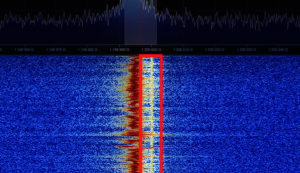
The reason this range mattered is explained directly in the transcript. The narrator states that radio frequencies from 1.4 to 1.8 GHz can indicate Earth-to-space or space-to-Earth communication, and might also signal the presence of a UAP. That does not mean every signal in that range is mysterious, and it does not mean the reading identified the source. It simply explains why the team paid attention once activity appeared there instead of dismissing it as ordinary background noise. For viewers, this is the important distinction: the range was not chosen because it guarantees a paranormal result. It was watched because it sits in a part of the spectrum that may be relevant when investigators are trying to rule out ordinary explanations and document unusual aerial or signal activity.
Why Not Watch Every Frequency at Once?
The question of why the team focused on 1.4–1.8 GHz instead of every other frequency is really a question about investigative strategy. The radio spectrum is enormous, and not every part of it is equally useful during a specific experiment. Some ranges are filled with common broadcasts, consumer devices, aircraft communication, or everyday interference. Others may be quieter, more specialized, or more useful when looking for unexpected signal behavior. In this case, the team began with broad spectrum awareness, but the notable changes appeared in a window the episode identified as potentially connected to communication between Earth and space. That gave the range a stronger reason to remain under close attention.
This is also why the timing of the 192-hertz tone became so important. The investigation was not simply asking, “Can we find any signal anywhere?” It was asking whether a specific environmental prompt might coincide with measurable changes. When the tone played, the team saw multiple peaks appear in the 1.4–1.8 GHz region, and then observed that the activity seemed to fade or return in a sporadic way. Andy described the energy as scattered rather than clean, which made it harder to classify quickly. That pattern appears to raise questions because the signal did not behave like a simple, steady transmission that could easily be waved away in the moment. Still, the team did not claim to know what caused it.
The range also became more interesting because of what happened around the same time. As the radio peaks appeared, the UFODAP system alerted the team to something in the sky, and the FLIR thermal camera captured moving heat signatures. Some objects appeared to move quickly, while others seemed to share similar shapes, sizes, or temperature ranges despite different speeds. Flight tracker and satellite tracker tools did not immediately identify the objects as known aircraft or satellites. That combination does not prove a connection between the signal and the aerial observations, but it could point to why the team treated the frequency range as significant. When unusual signal data and unusual sky data happen close together, investigators have a reason to slow down, compare instruments, and ask whether the overlap is meaningful or coincidental.
What the 1.4–1.8 GHz Readings Mean for the Larger Mystery
The 1.4–1.8 GHz readings matter because they show how the ranch investigation often operates at the edge between pattern and uncertainty. A spike on a spectrum analyzer is not dramatic in the same way as a visible object crossing the sky. Yet it may be more valuable because it gives researchers a measurable event that can be reviewed, compared, and tested against other data. The team was not just reacting to a strange sighting. They were watching instruments, noting timing, checking trackers, and trying to understand whether the environment had changed after the tone was introduced.
At the same time, the readings remain unresolved. The transcript does not establish the signal source, and it does not state that the 192-hertz tone caused the peaks to appear. It only shows that the team noticed a possible correlation and considered it important enough to discuss. That careful boundary is essential for any clean entertainment analysis of the ranch mystery. The signal may suggest that certain frequency ranges deserve more attention in future experiments. But it has not been confirmed as evidence of a specific object, intelligence, technology, or hidden mechanism.
For longtime followers of the investigation, the 1.4–1.8 GHz moment is compelling because it adds another layer to the larger pattern of strange but incomplete clues. Skinwalker Ranch has always been defined by fragments: unusual readings, strange aerial observations, environmental changes, and moments that appear connected but resist easy explanation. This frequency range became important not because it delivered a final answer, but because it gave the team a specific signal window to study when other instruments were also reacting. That makes it a potential roadmap for future experiments rather than a finished conclusion. The mystery remains open, and the most valuable thing about the 1.4–1.8 GHz range may be that it helps investigators ask a sharper question: when something unusual happens at the ranch, where in the spectrum does the first clue appear?
