
Expedition Unknown hidden Templar tower investigations rarely begin with silence—but this one did. Deep inside a forgotten Knights Templar commandery in southern France, Josh Gates stood before a stone tower that seemed to defy every rule of medieval architecture. There were no stairs. No visible entrance to its upper levels. Only strange recesses carved into the walls and an unnaturally deep opening that refused to explain itself. Then, just a short distance away, the earth revealed the first sign that the greatest secret of the site had never been hidden inside the tower… but beneath it.
The Tower That Was Never Meant to Be Climbed
For centuries, the isolated Templar commandery sat quietly among the rolling landscape of southern France, attracting scholars but surrendering almost none of its answers. Unlike grand castles or famous crusader fortresses, this forgotten outpost appeared almost ordinary—until Josh Gates and archaeologist Janet began examining a tower that simply should not have existed in its current form. Every medieval defensive tower required access. This one offered none. No staircase spiraled upward. No obvious doorway connected its mysterious upper chamber. Instead, carefully carved wall niches and a deeply recessed opening hinted that the structure had been designed with a purpose modern historians had long overlooked.
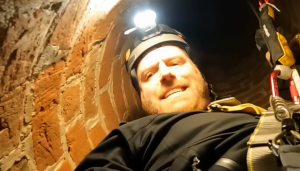
Standing beneath the weathered stone, the team realized they were confronting more than an architectural curiosity. Every unexplained feature raised a disturbing possibility that the tower had never been intended as a lookout at all. If it wasn’t built to protect those inside, what exactly had it been guarding? As old maps, historical records, and the physical evidence refused to align, the mystery only deepened. It felt less like discovering a forgotten building and more like approaching a carefully constructed secret that had survived nearly seven centuries.
Every Layer of Earth Pulled the Team Closer to the Truth
The investigation soon shifted away from the silent tower after subtle disturbances in the surrounding ground caught the archaeologists’ attention. The uneven soil suggested that something ancient lay hidden beneath the surface, untouched by generations of visitors. Each careful movement of the excavation tools carried enormous tension because disturbing medieval graves demanded extraordinary precision. Then came the first breakthrough—a silver coin dating to the 14th or 15th century emerged from the soil, quietly confirming that the location had remained connected to the final centuries of the Knights Templar era.

But the coin proved to be only the beginning.
As excavation continued, the team uncovered one burial after another, all carefully aligned on an east-west axis. Instead of isolated graves, multiple individuals had been laid within the same burial space, stacked through time in a manner suggesting that this ground had held profound importance. Every new skeleton transformed the excavation from a routine archaeological dig into something far more significant. The discoveries hinted that this was not a random cemetery serving local villagers, but a sacred place repeatedly chosen for individuals whose identities carried unusual meaning. With every layer removed, the forgotten commandery began revealing itself not simply as a military outpost, but as a place where history had deliberately buried its own guardians.
The Forgotten Resting Place That May Reveal the Templars’ Greatest Legacy
Among the burials, one skeleton immediately commanded the attention of the research team. Remarkably preserved despite centuries beneath the earth, the individual rested with crossed arms and an east-west orientation—details that closely matched documented Templar funerary traditions. Beneath this individual lay additional remains, reinforcing the possibility that generations of members of the medieval order had been laid to rest within the same sacred ground. Rather than uncovering a single remarkable grave, the excavation appeared to expose an entire burial tradition that had remained hidden beneath the forgotten commandery for hundreds of years.
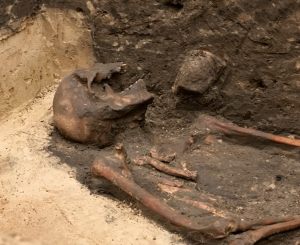
The discovery carries significance far beyond the excitement of finding medieval remains. Popular imagination has long portrayed the Knights Templar as guardians of immeasurable treasure, mysterious relics, or legendary objects lost to history. Yet the evidence emerging from this quiet hillside tells a far more human—and perhaps more extraordinary—story. Instead of gold, the excavation reveals ritual, belief, loyalty, and the final resting place of men whose lives shaped one of history’s most enigmatic military orders.
Ironically, the greatest discovery may not be what the Templars hid, but what they chose to leave behind. The inaccessible tower, the unexplained architectural features, and the carefully arranged cemetery now appear to form pieces of the same forgotten narrative. Together they suggest that this isolated commandery may have served not merely as a defensive position, but as a place where memory, identity, and sacred tradition were fiercely protected long after the order itself faded into legend.
For Josh Gates and the archaeological team, every unanswered question now feels larger than the last. If this forgotten burial ground represents only one hidden chapter of the Knights Templar story, how many more commanderies still conceal evidence capable of reshaping what we believe about one of medieval history’s most mysterious brotherhoods? Sometimes the greatest expedition is not the search for legendary treasure—it is the moment history finally allows the voices of the forgotten to be heard again.
