
A Short Appearance With a Long Shadow

What made his appearance memorable was not the length of time he spent on screen, but the direction he pushed the conversation. Oak Island often moves between physical evidence and historical theory, and Travis seemed comfortable standing exactly in that space. He brought attention to ideas involving Freemasonry, “as above, so below,” and the possibility that the sky may have been used as a kind of symbolic guide. That does not mean the theory has been confirmed, and it does not mean the island has suddenly become a celestial map. It means his interpretation gave the team another way to read the clues already on the table. For a mystery built on layers, that kind of perspective can be extremely valuable.
His brief role also worked because Oak Island does not need every contributor to be present in every scene. Some people are important because they dig, test, scan, or detect. Others are important because they ask a question that changes how everyone else looks at the evidence. Travis belonged to the second category during his appearance. Even if his contribution was short, it created a possible bridge between symbols, geometry, old belief systems, and the physical landscape of the island. That bridge may not lead to a final answer, but it gives the investigation a new corridor to explore.
Why His Perspective Felt So Important
The reason Travis’s contribution felt significant is that Oak Island has reached a stage where ordinary explanations are no longer enough to hold the entire story together. The team has spent years examining the Money Pit, the swamp, Lot 5, old roads, artifacts, underground anomalies, and theories tied to European history. Each discovery adds something, but the island still refuses to become simple. A single object may raise questions about age. A symbol may raise questions about meaning. A strange alignment may raise questions about design. Travis’s strength is that he is willing to consider whether scattered clues might belong to a larger pattern, while still leaving room for uncertainty.
His approach is especially interesting because it does not depend on sensational claims. Some viewers may associate him with investigations into unusual phenomena elsewhere, but on Oak Island his role felt more grounded. He was not making the island about aliens, portals, or impossible explanations. Instead, he was looking at human systems of meaning: Freemasonry, symbolic language, celestial observation, and the old philosophical idea that what appears above may be reflected below. That is a much cleaner and more useful angle for Oak Island. It gives the mystery depth without dragging it away from history.
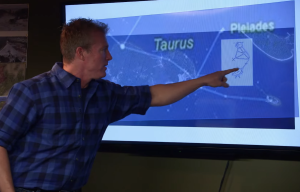
The Freemasonry angle matters because Oak Island has often been linked to theories involving secrecy, geometry, coded symbols, and ritual knowledge. These ideas should be handled carefully because resemblance is not proof, and symbolic interpretation can easily go too far. Still, the team wondered whether certain patterns could point to a mindset rather than a simple hiding place. If someone in the past used symbols or the night sky to organize meaning on the ground, then the island’s mystery may not only be about where to dig. It may also be about how to read the landscape. Travis’s appearance was important because he helped frame that possibility in a way that felt structured rather than reckless.
This is where the question of a bigger future role becomes interesting. If Oak Island continues to follow symbolic, astronomical, or Masonic-style theories, Travis could offer a useful outside lens. He would not need to become the central figure, and he would not need to appear in every episode. A recurring role as a specialist voice could make sense if the team keeps exploring questions about alignments, maps, and hidden design. Of course, there has been no confirmed announcement that he has signed a new contract or become a permanent member of the team. But based on the kind of contribution he made, it is easy to understand why some viewers may wonder whether the door has been left open.
The value of bringing him back would depend on how the investigation uses him. If his role became too broad or too dramatic, it could risk pulling attention away from the grounded evidence that gives Oak Island credibility. But if he returned as a focused specialist, someone who helps test unusual ideas rather than simply promote them, his presence could add real texture. The island benefits from people who can challenge assumptions without making unsupported conclusions. Travis fits that role because he brings curiosity, pattern recognition, and a willingness to ask questions that others might avoid. In a mystery this old, a fresh question can sometimes be as important as a fresh find.
A Possible New Voice, Not a Final Answer
The idea of Travis Taylor becoming a new member of the Oak Island team is intriguing, but it should be treated as speculation unless an official announcement says otherwise. His short appearance may suggest that the producers and team see value in his perspective, but a guest contribution is not the same as a long-term contract. Still, television mysteries often evolve by introducing voices who can open new angles. If Travis returns, it would likely be because his way of thinking helps connect clues that are difficult to interpret through digging alone. That possibility is worth discussing, even if it remains unconfirmed.
What makes Travis a strong fit is not that he has all the answers. It is that Oak Island needs people who can move between hard evidence and unusual interpretation without collapsing one into the other. The island’s clues often sit in that uncomfortable middle ground. A piece of metal is real, but its meaning may be uncertain. A pattern may be visible, but its intention may remain unclear. A theory may be compelling, but still lack the evidence needed to stand. Travis’s role could be useful precisely because he seems comfortable living inside that tension.

If he does become a recurring presence, his best contribution would be as a careful challenger of the team’s assumptions. He could help ask whether a pattern is meaningful or coincidental. He could explore whether symbolic systems, star references, or Masonic ideas have any reasonable connection to the evidence. He could also help push back when a theory becomes too tempting without enough support. That kind of role would not replace the archaeologists, historians, metal experts, or field investigators already involved. It would add another lens to a mystery that has always required more than one way of seeing.
In the end, Travis Taylor’s brief appearance mattered because it felt like more than a cameo. It gave Oak Island a new kind of question, one that looked upward to the sky while still remaining tied to the ground. Whether that leads to another appearance, a recurring role, or nothing more than a memorable contribution remains unclear. No contract or permanent team position should be assumed without confirmation. But the reason the idea feels believable is simple: Travis brought something the island can use. He did not solve the mystery, but he may have helped show why the next important clue might not only be found beneath the surface, but also in the way the surface is read.
