
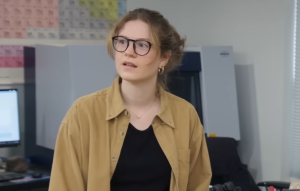
Oak Island has always had its larger-than-life figures: determined brothers, seasoned diggers, metal-detecting experts, historians, archaeologists, and local voices who carry the weight of the island’s long memory. But in recent seasons, Emma Culligan has brought something noticeably different to the table. Her work does not rely on bold declarations or dramatic guesses. Instead, she represents a quieter kind of suspense: the careful reading of metal, material, composition, and age. With her background in archaeology, engineering, and metallurgy, Emma gives the investigation a sharper scientific edge, especially when artifacts arrive from the field with more questions than answers. She is not presented as someone who can settle the island’s mystery on her own. Yet her presence may suggest why the search now feels less like a simple treasure hunt and more like a layered investigation into the island’s hidden past.
The Specialist Behind the Lab Table
Emma’s role becomes most visible when the field team brings newly discovered artifacts back for technical analysis. While figures like Rick and Marty Lagina often carry the emotional drive of the search, and Gary Drayton brings energy to the metal-detecting side, Emma’s contribution is built around interpretation. Her job is not simply to say whether something looks old or interesting. She helps examine what an object is made of, how it may have been created, and whether its composition could point to a certain time period or historical context. That kind of work matters because Oak Island has produced many objects that seem intriguing at first glance but need careful testing before they can be meaningfully understood.

According to Sky HISTORY, Emma Culligan joined the island team in the tenth season and became known for operating systems such as XRF, or X-ray fluorescence, and XRD, or X-ray diffraction, to analyze metals and other artifacts. The same source notes that she studied engineering and archaeology, later moving into metallurgy, which helps explain why her role sits between science and history. In the world of Oak Island, that combination is valuable because an object’s appearance can be misleading. A small piece of metal may look ordinary until its chemical makeup suggests something older, rarer, or more complicated. Emma’s work gives the team a way to move beyond first impressions.
One of the clearest examples of her impact came with a trade weight found on Lot 7. The official HISTORY map states that Gary Drayton and Jack Begley discovered the item in 2022, and that Emma determined it contained arsenical bronze. She reportedly informed the team that the use of that compound in metallurgy ceased after 1500 A.D., meaning the artifact could be at least 500 years old. That does not solve the island’s central mystery, and it does not identify who brought the object there. But it shows why Emma’s role matters: she can turn a small, quiet object into a serious historical question.
Why Emma’s Analysis Adds a New Kind of Suspense
Emma’s presence is compelling because she changes the rhythm of the investigation. Oak Island has always had dramatic moments: a drill hitting something unexpected, a metal detector ringing in the soil, a tunnel theory resurfacing, or a swamp feature raising new questions. But her scenes create tension in a different way. The suspense comes from waiting for data, not from watching machinery tear into the ground. When an artifact enters the lab, the question becomes more precise: what is this object really telling the team? That shift gives the search a more modern and credible feeling.
This is especially important because the island’s mystery depends on separating possibility from proof. A coin, spike, lead object, or metal fragment can invite speculation, especially when it appears in a location already loaded with theory. But scientific analysis can narrow the field of interpretation. It may suggest that an item is older than expected, or that it was made using materials associated with a particular tradition or period. At the same time, it can also stop a theory from going too far by showing that an object does not support the most dramatic explanation. Emma’s work therefore adds excitement without needing to overstate the evidence.
Her role also matters because Oak Island has become more than a search for treasure. Over time, the investigation has expanded into a study of timeline, movement, settlement, maritime activity, and possible links to older European history. That means the team needs more than enthusiasm and persistence. They need people who can read the physical evidence in a disciplined way. Emma’s analysis may suggest whether an artifact belongs to a colonial period, a medieval possibility, or a later layer of activity, though each conclusion depends on the limits of the available evidence. This is where the show feels most valuable for people interested in the mystery: it demonstrates that every object has to earn its place in the story.
There is also a human reason Emma has become so noticeable. She does not dominate the room with sweeping theories. Instead, her appeal comes from focus, clarity, and the sense that she is letting the evidence speak before the story takes over. In a series where speculation can easily become dramatic, that restraint gives her scenes a different kind of authority. Viewers are not just watching someone react to a find; they are watching someone slow the mystery down long enough to ask better questions. That makes her presence feel refreshing, especially in a season where audiences are looking for clues that actually move the investigation forward.
The team has often wondered whether certain artifacts could point to older activity on the island. Emma’s work does not automatically answer those questions, but it helps shape them. If a metal object contains unexpected elements, that may suggest a different manufacturing context. If a test narrows a possible age range, it could point to a timeline worth exploring further. If the results are inconclusive, that also matters, because it keeps the theory from becoming stronger than the evidence. In that sense, Emma’s role is not only about discovery; it is about discipline.
A Fresh Lens on an Old Mystery
Emma remains important because she represents where the Oak Island investigation seems to be heading. The search is still filled with mystery, atmosphere, and long-standing legends, but it increasingly depends on specialists who can turn discoveries into usable information. Her work helps bridge the gap between the emotional pull of the island and the scientific process needed to study it responsibly. That balance is essential because Oak Island’s story has always attracted big theories. Without careful analysis, every object could become whatever people want it to be. With analysis, each clue becomes more grounded, even if the larger mystery remains open.
Her presence also helps explain why the search can still feel new after so many seasons. A familiar location becomes interesting again when a specialist can uncover something hidden in the material itself. A small artifact becomes more than a prop when its composition raises questions about origin, use, or age. The island’s story gains depth when science and speculation are held in tension rather than collapsed into one easy answer. Emma’s role may not offer the kind of dramatic breakthrough some viewers hope for, but it gives the investigation a sharper, more thoughtful edge. That may be just as important as a spectacular find.

In the end, Emma does not make Oak Island less mysterious; she makes the mystery more interesting. Her analysis does not close the case, and it should not be treated as proof of any single theory. What it does is give the search a stronger framework for asking what the clues might mean. The island still holds its secrets tightly, and many questions remain unresolved. But with voices like Emma’s at the table, the investigation feels better equipped to separate a tempting story from a meaningful clue.
That is why her role continues to stand out. She brings a modern lens to an old legend, a measured voice to a world of speculation, and a scientific method to a mystery that has often lived in the space between fact and folklore. For longtime followers, that makes the search feel renewed rather than repetitive. For newer audiences, it offers a clear way into the complexity of the island. Oak Island may not be ready to give up its final answer, but Emma’s work may reveal why the smallest objects can still carry the biggest questions.
