
The swamp may have just exposed one of its most intriguing secrets yet. During a metal-detecting sweep, the team uncovers an ornate gold pendant with a clear central stone—too refined, too deliberate, and too carefully hidden to feel accidental. It does not look like something the swamp simply swallowed. It looks like something someone meant to protect. And that changes the feeling around the entire search. Because a pendant is not just treasure. It is personal.
The swamp finally gave up something that felt intentional
Oak Island’s swamp has always carried a strange reputation. It is not just difficult ground. It feels loaded. Heavy. Secretive. Every sweep, every excavation, every pass with a detector seems to test whether the island will reveal something meaningful or simply drag the team deeper into uncertainty. That is why this find feels so different.
An ornate gold pendant with a clear central stone does not read like random debris. It reads like a decision.
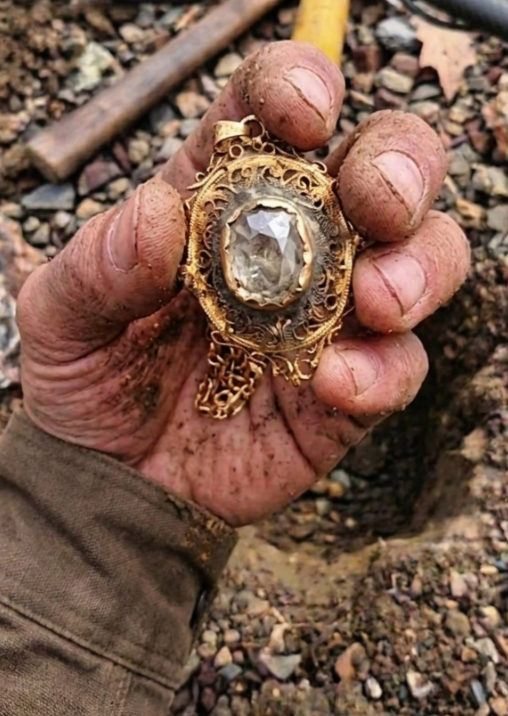
The first reaction is not about money, even if the object is clearly valuable. The first reaction is about craftsmanship. This was made with care. Someone shaped it, wore it, treasured it, and likely kept it close to the body. A pendant is intimate in a way many other finds are not. It does not sit in a chest. It hangs near the heart. It moves with the person who owns it. That gives the discovery a human pulse the moment it is uncovered.
And that is what makes the swamp feel more dangerous now.
Because once something this refined appears in a place like Oak Island, the question becomes harder to ignore: was it lost, or was it hidden?
That is where the emotional tension begins. A lost object suggests accident. A hidden object suggests purpose. And on Oak Island, purpose always changes the story. If this pendant was deliberately buried, then the swamp may have been used as more than a dumping ground or a natural trap. It may have been part of a concealment strategy. That means the team is not just looking at jewelry. They may be looking at a sign that someone once used this ground to keep a secret alive.
Why the pendant feels too personal to dismiss
What makes the pendant so compelling is not only its beauty, but its intimacy.
A gold pendant with a clear central stone feels symbolic. It suggests identity, belief, status, or protection. That stone at the center is especially important because it draws the eye immediately. It gives the object a kind of gravity, as if the pendant was meant to do more than decorate. It may have been worn for meaning rather than display. It may have marked rank, belonging, or devotion. It may have been a keepsake, a ceremonial item, or a token that mattered deeply to the person who wore it.

That is why the question of ownership hits so hard.
Who owned it?
Was it a noble figure? A traveler? Someone connected to a hidden operation? Was it worn by someone who knew exactly what the swamp was hiding? Or was it carried here by a person who never expected it to vanish into the island’s muddy silence?
The more the team studies the pendant, the more it feels like a clue to a life rather than just an artifact. That gives the discovery emotional weight. On Oak Island, people often talk about objects in terms of value, rarity, or historical importance. But a pendant like this invites a different kind of response. It reminds us that every buried object once belonged to someone who made a choice to wear it, protect it, or carry it across a dangerous place.
That makes the find quietly haunting.
Because the swamp may not have just preserved gold. It may have preserved a human story that was never meant to survive this long.
And once a story like that surfaces, the search becomes more than a hunt for hidden wealth. It becomes a search for the person behind the object.
The pendant may be pointing to something much bigger
The real power of this discovery is the possibility that the pendant is not the end of the story, but the beginning of one.
Oak Island rarely rewards the team with isolated finds that remain isolated. One object often leads to another. A coin suggests a route. A timber trace suggests construction. A strange artifact in the swamp suggests a larger pattern hiding beneath the mud. This pendant fits that pattern perfectly because it feels too deliberate to be random.
If it was hidden on purpose, then it may have been placed near something more important. A route. A chamber. A hidden cache. A marker used to identify where a larger secret had been sealed away. The pendant may have been part of a larger system of concealment, one meant to protect something of greater significance than the object itself.
That idea changes the entire search.
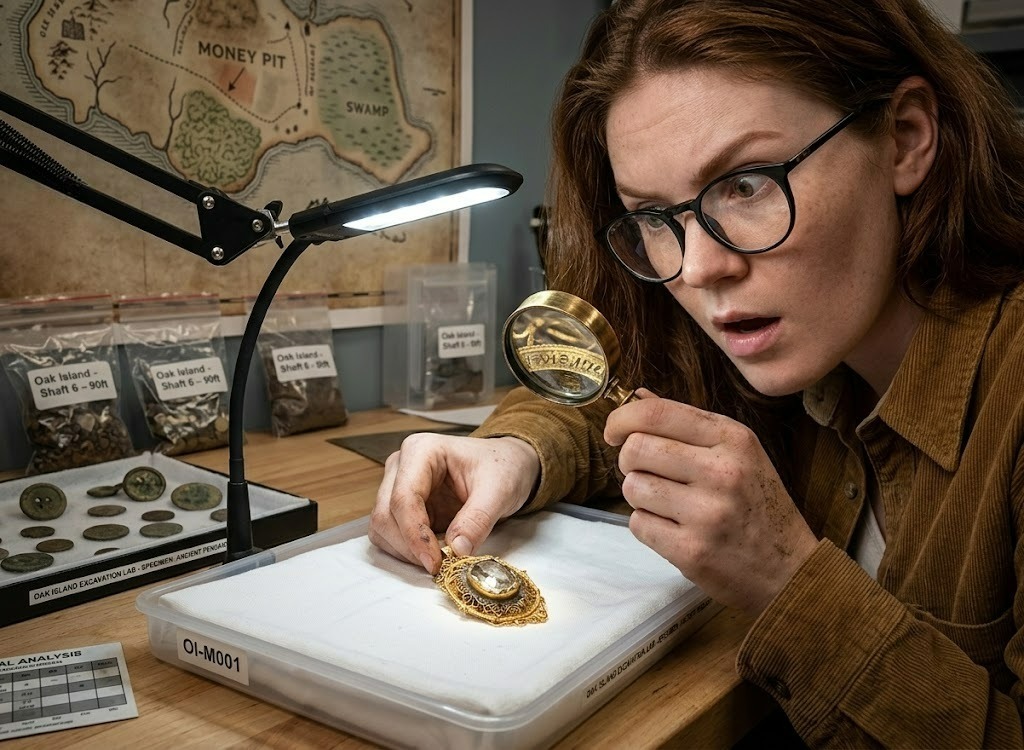
Because now the team is not only asking what the pendant is worth or where it came from. They are asking what it was protecting. That is the kind of question Oak Island loves to raise and refuses to answer too quickly. It creates tension because it suggests that the swamp is not just hiding relics. It may be guarding the edges of a much larger secret.
And that is what makes the discovery so emotionally strong. It carries the feeling that the team is standing at the edge of something private, something carefully hidden, something that belonged to a real person but now belongs to history.
Maybe the pendant was a cherished possession. Maybe it was a symbol of power. Maybe it was a marker left behind for someone else. Whatever it was, it survived because the swamp allowed it to. And now, after all this time, it has surfaced to ask one question the team cannot ignore:
If this pendant was hidden with intent, what else is still buried beneath Oak Island waiting to be found?
