
What if the greatest secret buried inside an ancient Etruscan tomb is not gold—but the answer to a civilization that has refused to explain itself for more than 2,500 years? Expedition Unknown follows Josh Gates into Italy’s monumental necropolises, where forgotten family tombs, ancient DNA, and LiDAR scans begin revealing clues that could rewrite one of archaeology’s oldest mysteries.
The Civilization That Left Thousands of Tombs… But Few Answers
Long before Rome ruled the Mediterranean, the Etruscans built one of the ancient world’s most sophisticated civilizations across central Italy. They engineered monumental necropolises carved directly into hillsides, constructed enormous tumuli for powerful families, and filled elaborate burial chambers with objects meant to accompany the dead into the afterlife. Yet despite the scale of their achievements, one mystery has never disappeared. No one has fully deciphered the Etruscan language, and historians have spent centuries debating who these people really were.
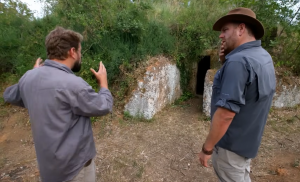
Some ancient writers believed the Etruscans migrated from Asia Minor. Others argued they originated in Greece before settling in Italy. Those competing theories survived for generations because archaeology could never provide a definitive answer. That uncertainty is what brings Expedition Unknown to one of Italy’s most extraordinary ancient cemeteries, where Josh Gates joins archaeologist Dr. David Caramelli and a multidisciplinary research team searching for evidence capable of separating historical speculation from scientific fact.
The necropolis itself feels less like a cemetery than an entire city built for eternity. Monumental family tombs line the landscape, their entrances disappearing beneath centuries of earth and vegetation. Every stone doorway suggests another story waiting behind it. Every unopened chamber carries the possibility that inscriptions, human remains, or forgotten grave goods may still preserve answers that history has failed to recover.
Ancient DNA Begins Rewriting One of History’s Greatest Debates
The first discoveries reveal just how remarkable these burial complexes remain. Although many of the family tombs were partially looted centuries ago, archaeologists continue recovering human remains, bronze artifacts, and architectural features that provide valuable insight into Etruscan society. Every burial chamber adds another piece to a civilization that has always seemed frustratingly incomplete.
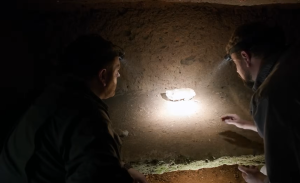
But the investigation takes an unexpected turn when archaeology meets modern genetics.
Instead of relying solely on ancient texts, researchers analyze DNA extracted from Etruscan skeletons. The results challenge one of the oldest theories in classical history. Rather than supporting migration from Asia Minor or Greece, the genetic evidence indicates that the Etruscans were indigenous to central Italy. The discovery does not solve every mystery surrounding their civilization, but it fundamentally reshapes the question of their origins. One of history’s longest-running debates suddenly begins leaning toward a very different conclusion.
Even so, perhaps the greatest mystery remains untouched. Scientists still cannot fully decipher the Etruscan language. Their inscriptions survive on tombs, monuments, and funerary objects, yet much of their written world remains silent. Without new archaeological discoveries, the civilization’s own voice may never be completely understood.
LiDAR May Reveal the Tombs That History Never Reached
That unanswered question is exactly why the investigation expands beyond the visible cemetery.
Rather than excavating blindly across the ancient landscape, the team deploys advanced LiDAR technology to scan hundreds of acres surrounding the necropolis. The laser mapping system penetrates dense vegetation, exposing subtle changes in elevation that could reveal hidden subterranean tombs invisible from the surface. Instead of searching one chamber at a time, investigators begin mapping an entire buried landscape that may have remained untouched for more than two thousand years.
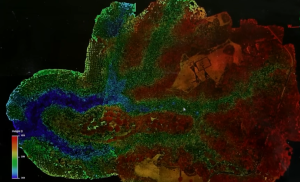
The significance of that search extends far beyond discovering another tomb. An undisturbed burial could preserve inscriptions still resting exactly where Etruscan families placed them. Grave goods, human remains, and untouched funerary architecture may survive together for the first time, providing the kind of complete archaeological context that researchers rarely encounter. Every newly identified anomaly becomes another possible doorway into a civilization whose language continues to resist modern understanding.
The available evidence does not promise that the next excavation will finally decipher the Etruscan language, nor does it guarantee that every hidden chamber will remain untouched. What it does demonstrate is that archaeology, genetics, and remote sensing are beginning to tell the same story. Ancient DNA has reshaped the debate over Etruscan origins. Monumental tombs continue revealing how this remarkable society honored its dead. LiDAR now offers the possibility of locating burials that escaped both looters and time itself.
If those hidden chambers still preserve inscriptions, the next excavation may uncover more than another remarkable tomb.
It may recover the missing words of an ancient civilization.
Because beneath the hills of central Italy…
The greatest Etruscan secret may not be who they were.
It may be what they were trying to tell us.
