
The latest investigation into the Skinwalker Ranch lidar dome anomaly pushed the ranch into a new and unsettling category of mystery. A helicopter, a 1.2 GHz transmission, and multiple layers of scanning technology all seemed ready to map the Triangle with precision—until the data began breaking down at exactly the same boundary. Above the line, the instruments behaved. Inside it, the numbers turned hostile.
The Sky Over the Triangle Refused to Stay Ordinary
Skinwalker Ranch has spent years earning its reputation as a place where sensors fail, signals distort, and aerial activity refuses to obey the rules that govern everywhere else. In Utah’s Uintah Basin, the Triangle has become the center of that resistance, a location where unexplained electromagnetic anomalies and persistent UAP sightings keep colliding with repeated equipment malfunctions. Earlier lidar surveys raised the possibility that the ranch might be hiding something far larger than a brief anomaly in the sky: a massive invisible dome surrounding the Triangle itself.
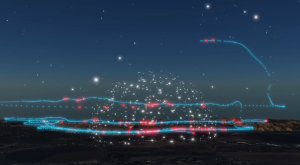
That possibility is what brought Brandon Fugal, Dr. Travis Taylor, Erik Bard, Pete Kelsey, and Irene Radcliffe back into the field with a more advanced aerial scanning plan. This time, the team used helicopter-mounted lidar, GPS tracking, and a dedicated 1.2 GHz radio transmission to see whether independent instrumentation could map the shape of the suspected structure with enough clarity to move beyond speculation. The goal was not simply to detect interference. The goal was to define the boundary of something invisible.
As the helicopter passed over the Triangle, the system began producing exactly the kind of response that transforms a technical test into a mystery. The instrumentation did not fail everywhere. It failed with precision. The data corruption appeared inside the suspected boundary, then vanished outside it and above roughly 3,000 feet, as if the anomaly were occupying a very specific volume of space and refusing to extend beyond its own limits. That pattern immediately suggested design, symmetry, or at the very least a physical boundary that was far more organized than random interference would allow.
When the Data Started Drawing the Shape for Itself
The most unsettling part of the experiment was not that the systems behaved strangely. It was that they behaved strangely in a way that looked consistent.
Helicopter-mounted lidar and GPS systems both generated corruption during repeated passes over the same region, but the damage did not spread indiscriminately across the flight path. Instead, it appeared to cluster inside the area investigators already suspected was part of the invisible dome. Once the helicopter moved beyond that zone—or climbed above the critical altitude—the corruption disappeared. That kind of consistency turns a nuisance into evidence. It suggests the anomaly is not merely disrupting instruments at random. It is acting within defined limits.
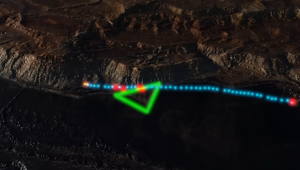
Then came the post-analysis, where the real shape of the mystery began to emerge.
When the team reviewed the lidar data in detail, they discovered a dome-shaped structure extending hundreds of meters beneath the ground, mirroring the aerial boundary investigators had already suspected above the Triangle. That detail changes everything. A simple atmospheric effect would not normally produce a matching formation below the surface. A transient signal disturbance would not typically leave behind a large, symmetrical structure in the scanned environment. The data appeared to suggest a geometry that crossed the boundary between sky and earth, as though the ranch were sitting inside a measured volume rather than an undefined disturbance.
That is where the investigation becomes truly difficult to ignore. The anomaly was no longer just a problem in the air. It was becoming a shape. A dome above. A dome below. A repeating boundary that seemed to occupy both the visible and the buried layers of the ranch at the same time.
If the Dome Is Real, the Ranch Has Been Hiding a System
No responsible conclusion can claim that the lidar data proves the existence of an artificial structure or an engineered containment field. The evidence supports a more cautious but still extraordinary interpretation: during repeated helicopter passes, GPS and lidar systems recorded corruption inside the suspected boundary, that corruption disappeared outside it and above 3,000 feet, and post-analysis revealed a dome-shaped form extending deep below the ground.
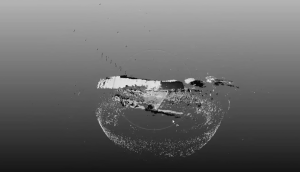
Taken together, those findings are hard to dismiss as random coincidence. They suggest a persistent anomaly with measurable limits, a structure-like presence that interacts with multiple independent instruments in ways that remain unexplained. If the shape is real, then the mystery of Skinwalker Ranch is no longer limited to strange lights, broken sensors, or isolated events around the Triangle. It becomes a question of scale.
What kind of phenomenon creates a boundary both above and below the ground? Why does it disrupt only certain systems in a defined region? And why does the data imply a symmetry that looks far too deliberate to be accidental?
That is what makes this investigation so unnerving. The ranch is not just producing anomalies. It is appearing to outline them. The helicopter did not merely fly through strange air. It passed through a zone where the environment seemed to reject clean measurement, then revealed a form that may have been hidden in plain sight all along.
If the Triangle is sitting inside a massive invisible dome, then the most important discovery is not just that something strange exists there.
It is that the ranch may have been built on top of a system that has been there the entire time, waiting for the right instruments to finally trace its edge.
