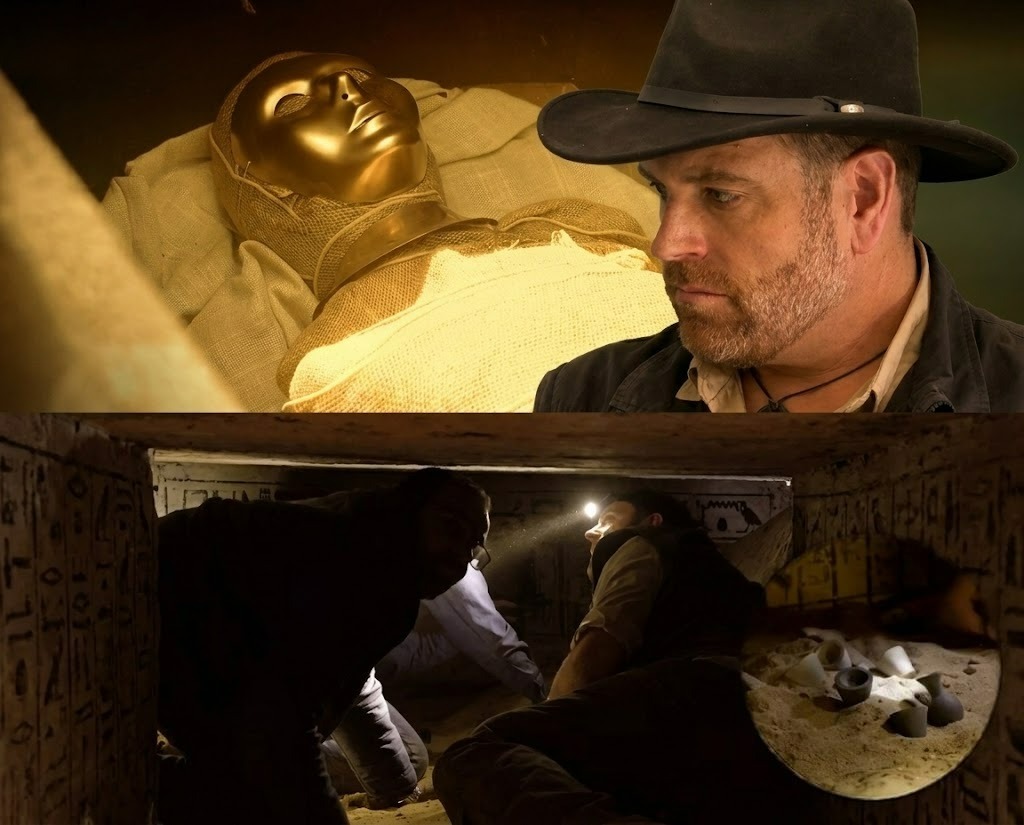
Global Raider captures Josh Gates at his most ambitious, as discoveries tied to lost bloodlines, ancient tombs, and buried civilizations turn one expedition-driven story into a sweeping look at how history can change in a single moment.
Global Raider Opens With a Search for Power, Bloodline, and Legacy
Global Raider is the kind of phrase that feels built for a story like this, because the scope is enormous from the very first line. Across the wild steppes of East Asia, the dense jungles of Guatemala, and the underground passages of Saqqara, the idea is not simply that archaeologists are uncovering objects. They are uncovering identities, dynasties, and histories that were never meant to stay hidden forever. Josh Gates, in the center of that storm, becomes less of a host and more of a guide through a world where every discovery threatens to rewrite what people thought they knew.

The fascination with Genghis Khan’s lost bloodline alone would be enough to fuel a season of storytelling. The idea that traces of a legendary ruler could still be emerging from the earth carries a special kind of electricity, because it touches both science and myth at once. A bloodline is not just a genetic trail. It is a human link to power, empire, and survival. That is why the story feels so much bigger than one archaeological find. It is about the possibility that history’s most famous names are still speaking to the present, if only we are patient enough to listen.
What makes Global Raider so effective as a headline and as a concept is the momentum it creates. It suggests motion, urgency, and reach. Gates is not standing in one place describing history from a distance. He is moving through it, crossing borders and pulling together discoveries that, on the surface, seem unrelated but emotionally feel like one long thread. That thread is what keeps the audience locked in: the sense that the past is not finished with us yet.
The Forbidden Tombs Add a Darker, More Intimate Kind of Thrill
The discoveries in Saqqara bring a different energy to the story. Unlike the grand scale of lost empires or bloodline mysteries, a tomb feels deeply personal. It is intimate in a way that few archaeological finds can be. A perfectly preserved tomb does more than reveal artifacts. It preserves a final moment in time, a carefully arranged message from the living to the dead. That is why the image of an ancient Egyptian prime minister’s resting place is so powerful. It is not only about what was buried. It is about the intention behind the burial.

That tension between spectacle and silence is what makes the story resonate. A tomb can be visually breathtaking, but the emotional force comes from knowing that someone once lived, ruled, and was eventually sealed away with all the expectations of their era. The result is a haunting reminder that history is not only made of victories and kingdoms. It is also made of endings, rituals, and the powerful need people have to be remembered. Gates’ storytelling style gives that kind of find real weight because he understands that discovery is never only about the object. It is about the life attached to it.
In that sense, Global Raider works because it never stays on the surface. The phrase may sound bold and cinematic, but the material beneath it is surprisingly human. A lost bloodline speaks to family and continuity. A tomb speaks to mortality and memory. Together, they create a kind of archaeological drama that feels both epic and intimate. That balance is hard to achieve, and it is exactly why stories like this stay with people long after the episode ends.
Why This Story Makes History Feel Alive Again
The real power of Global Raider is that it turns archaeology into a living, breathing event rather than a distant academic subject. Too often, history is presented as something sealed off behind glass or locked inside textbooks. But when a story connects three continents, multiple ancient worlds, and a host like Josh Gates, it suddenly feels immediate. The audience is not just hearing about the past. They are watching it surface in real time.

That immediacy matters because it changes how people respond to discovery. Instead of treating an ancient tomb or a genetic clue as isolated facts, viewers begin to see patterns: movement across land, power passed down through generations, and civilizations still speaking through what they left behind. The emotional effect is powerful. It reminds us that history is not fixed. It is revised every time someone finds something new, asks a better question, or dares to look deeper than the last explorer did.
In the end, Global Raider feels so compelling because it captures the best kind of history story: one that is bigger than a single country, bigger than a single era, and bigger than any one answer. Josh Gates becomes the thread connecting all of it, not because he solves everything instantly, but because he knows how to carry the audience through the mystery with curiosity and conviction. That is what makes the story unforgettable. It is not just about hidden kings or forbidden tombs. It is about the thrilling moment when the ancient world suddenly feels closer than ever.
